Connect With Us:

.svg)

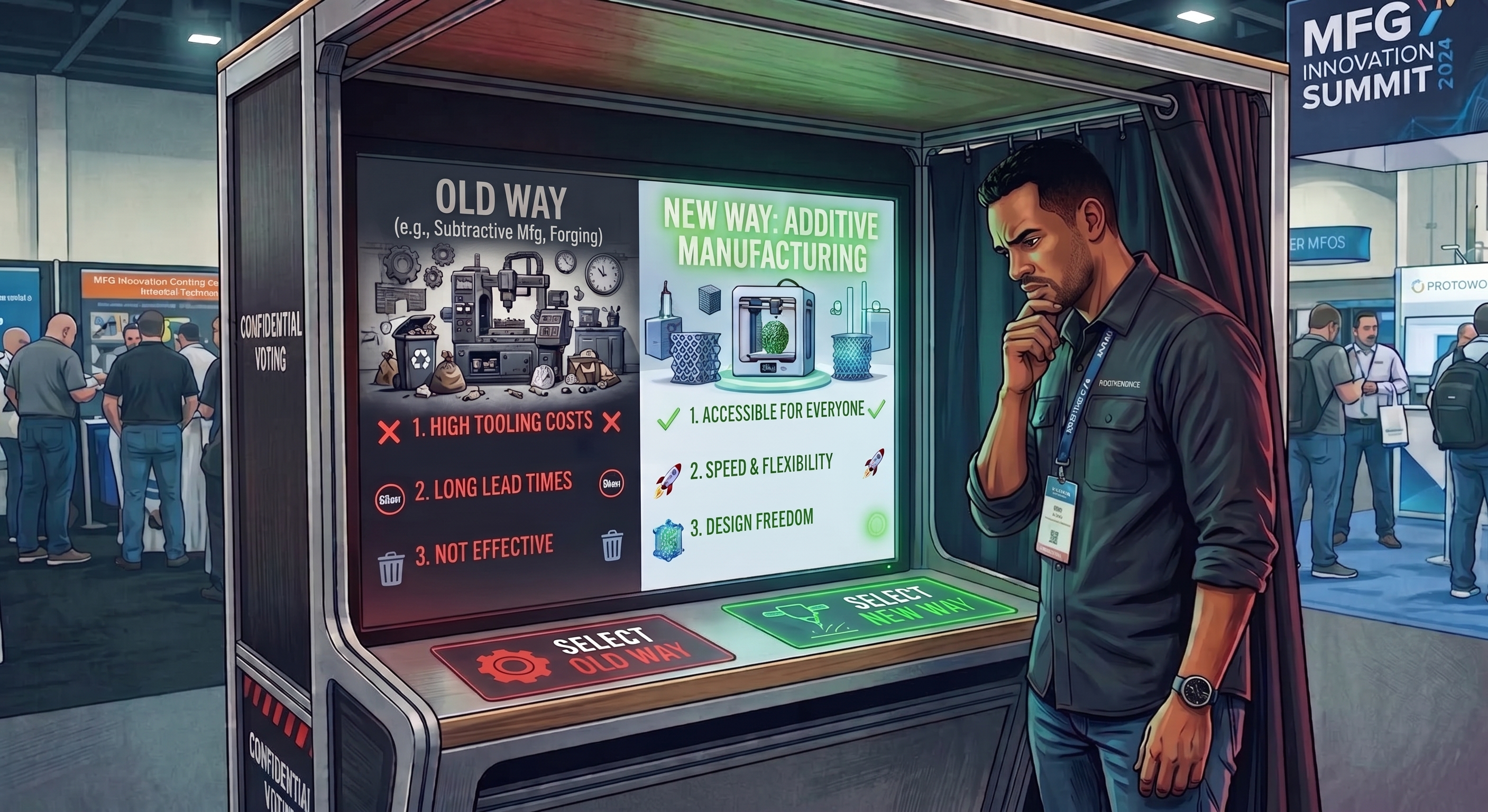
For most of manufacturing history, getting a custom structural part made meant clearing two hurdles most small businesses couldn't clear: capital and expertise. Tooling costs, engineering overhead, and minimum order quantities kept custom manufacturing locked behind companies large enough to absorb all three. 3D printing has quietly closed that gap — and a recent job we ran is a good illustration of just how much has changed.
A playhouse — a theater that stages live productions — came to us needing four different custom structural parts built for their set pieces. Each part weighed roughly 500 grams and had to hold up under real use on stage — these weren't decorative pieces. In total, they needed about 100 units across the four designs.
Fifteen years ago, a request like that would have followed a very different — and much more expensive — path. To get parts like these made, the playhouse would have needed:
For a run of 100 pieces, that math simply doesn't close. A small manufacturer in that position historically had three options: overpay dramatically, over-order parts they don't need to justify the tooling, or shelve the idea.
3D printing removes the tooling step entirely. Because parts are built directly from a digital file, there's no mold to cut, no steel to machine, and no minimum volume required to make the job worth doing. The cost scales down to fit the order, rather than forcing the order to scale up to fit the cost.
For the playhouse, that meant:
This is the real story behind the democratization of 3D printing. It isn't just that printers got cheaper — it's that the two things that used to gate custom manufacturing behind large companies, capital and expertise, are no longer required in the same way. A small theater company can now get structural parts made with the same rigor as a company running its own engineering department, at a volume and price that actually fits the business.
It's also worth noting where this is heading: experienced toolmakers and manufacturing engineers are retiring faster than they're being replaced. That gap between needing a custom part and having the expertise to get one made correctly would only be widening — if additive manufacturing hadn't stepped in to close it.
If you've got a structural part — or a handful of different ones — that needs to go from idea to finished pieces without a five-figure tooling bill or a months-long wait, that's exactly the kind of project we take on. Get in touch or run it through our instant quote to see what a batch like this actually costs.